
UAE Labour Law 2026: Notice Period, Resignation & Leave Guide

The UAE Labour Law for private-sector employment is governed by Federal Decree-Law No. 33 of 2021 and its amendments. It covers employment contracts, notice periods, probation, resignation, leave, wages, termination, end-of-service benefits and labour disputes. This guide explains the rules that private-sector employees most commonly need when joining, leaving or dealing with an employment issue.
The law applies to UAE private-sector employment, subject to the exclusions and special frameworks provided by UAE legislation. Federal and local government employees, members of the armed forces, police and security, and domestic workers follow separate legal frameworks. Employees working in free zones should also check the rules applicable to their specific authority, while DIFC and ADGM have separate employment frameworks.
UAE Labour Law 2026: What Is Current?
As of September 2026, Federal Decree-Law No. 33 of 2021, together with its amendments, remains the main federal framework governing private-sector employment in the UAE. The law has been amended by subsequent federal decrees, including Federal Decree-Law No. 20 of 2023 and Federal Decree-Law No. 9 of 2024.
There is no replacement of Federal Decree-Law No. 33 of 2021 with a completely new federal private-sector labour law in 2026. However, employees should also check current MOHRE resolutions and government guidance because employment procedures, wage-protection requirements and government services can be updated without replacing the main Labour Law.
This page was reviewed in September 2026 against current UAE Government and MOHRE guidance. Where a rule depends on the employment contract, work permit, free-zone authority or specific circumstances, this guide identifies that instead of applying one rule to every employee.
Who Does the UAE Labour Law Apply To?
Federal Decree-Law No. 33 of 2021 is the main federal employment law for UAE private-sector employment. It applies to private-sector employers and workers, subject to the categories excluded by the law. Federal and local government employees, members of the armed forces, police and security, and domestic workers are outside its scope.
Employees working in free zones should check the rules applicable to their specific authority. DIFC and ADGM, for example, operate under separate employment frameworks.
Notice Period Under UAE Labour Law
Under Article 43 of the labour law, either party can end an employment contract by giving written notice, for a period agreed in the contract of no less than 30 days and no more than 90 days. The notice period is generally the same for both parties unless a different arrangement is more favourable to the worker. The employment contract must provide a notice period of at least 30 days and no more than 90 days.
For practical protection, give your resignation in writing and keep evidence showing when the employer received it.
Notice Pay If the Notice Period Is Not Served
If either party fails to serve the agreed notice period, the party that does not comply may be required to pay the other party compensation in lieu of notice. Under the UAE Labour Law, the notice-period allowance is calculated according to the worker’s last wage, subject to the applicable circumstances and legal requirements.
A Worked Notice Period Example
Notice Period Example
Day 1
Your employer receives your written resignation on 5 September.
Notice Period Begins
The notice period is generally calculated from the date the resignation is received, subject to the terms of your contract and applicable rules.
Last Working Day
If your contract requires a 30-day notice period, the exact last working day should be confirmed using the applicable date-counting rules and the date your employer received the resignation.
The Unpaid Job Search Day
If the employer terminates the contract, the employee is entitled to one unpaid working day per week during the notice period to look for another job. The employee must notify the employer at least three days before the intended day of absence. This statutory job-search leave is specifically provided for employer-initiated termination.
Notice Period During Leave
If either side wants to end the contract while you are on approved leave, the notice period does not start until the day after you return, unless both parties agree otherwise.
Notice Period During Probation
A probation period in the UAE private sector cannot exceed six months from the employee’s start date. If the employer terminates the employment during probation, the employer must give at least 14 days’ prior written notice.
If an employee wants to move to another employer in the UAE during probation, the employee must give the current employer at least one month’s written notice. The new employer must compensate the current employer for the recruitment or contracting costs, unless otherwise agreed.
If a foreign employee wants to leave the UAE during probation, the employee must give at least 14 days’ written notice. If the employee returns to the UAE and obtains a new work permit within three months of departure, the new employer must pay the recruitment-cost compensation described above, unless the worker and previous employer agreed otherwise.
Because probation rules differ from the standard 30-to-90-day notice framework, employees should confirm the reason for leaving and the applicable contract terms before setting a final working date.
Old Law Article Numbers vs Current Law
Since so much confusion comes from mismatched article numbers, here is a quick reference for the topics covered on this page.
| Topic | Old Law | Current Law |
|---|---|---|
| Termination without notice by employer | Article 120 of Federal Law No. 8 of 1980 | Article 44 of Federal Decree-Law No. 33 of 2021 |
| Resignation without notice by employee | Article 121 of Federal Law No. 8 of 1980 | Article 45 of Federal Decree-Law No. 33 of 2021 |
| End-of-service gratuity | Article 132, with rules that included resignation-related reductions | Article 51, based on the current end-of-service benefit rules |
| Unlawful termination | Older provisions and case-law concepts under the previous framework | Article 47 of Federal Decree-Law No. 33 of 2021 |
Many older UAE labour-law guides cite the repealed Federal Law No. 8 of 1980. Always check whether an article reference belongs to the old law or the current Federal Decree-Law No. 33 of 2021.
How to Resign the Right Way
Resigning correctly protects your final settlement and your ability to work for a new employer without complications.
- Submit your resignation in writing, dated and addressed to your employer, keeping a copy for your own records
- Confirm your notice period length against your employment contract rather than assuming a standard 30 days
- Continue working and receiving full pay throughout the notice period, unless you agree otherwise in writing
- If your employer terminated the contract, use the statutory unpaid job-search day available during the notice period after giving the required advance notice.
- Ask HR for your final settlement calculation and copies of the employment records you need before or at the end of your employment.
- Confirm your labour card cancellation timeline with HR, since this often runs alongside your final settlement processing
Following these steps in order reduces the chance of a dispute over your notice period, your final pay, or your ability to start a new role quickly.
Resigning Without Notice
Article 45 allows a worker to leave employment without the normal notice period in specific circumstances. These include certain employer breaches that are not remedied after the required MOHRE notification process, proven assault, violence or harassment, a grave workplace danger to the worker’s safety or health that the employer fails to address, and assigning fundamentally different work without the worker’s written consent except where legally permitted. The reporting and notice requirements differ by situation, so employees should follow the applicable MOHRE process before leaving without notice.
Early Resignation on a Fixed Term Contract
UAE private-sector employment contracts are concluded for a specific term, generally not exceeding three years, and may be renewed or extended by agreement. The stated end date does not by itself mean that an employee must remain until that date. Article 43 provides a general route for either party to terminate the contract with the applicable written notice period, subject to the Labour Law and the employment contract. Different rules apply during probation and where termination without notice is legally permitted.
Severance Pay and Your Final Settlement
“Severance pay” is not a single standard payment category under the UAE Labour Law. Depending on how employment ends, a final settlement may include unpaid wages, accrued annual-leave pay, end-of-service gratuity where applicable, notice-period compensation and, in specific circumstances, compensation ordered by a court.
For the gratuity portion of your final settlement, use our Gratuity Calculator UAE to estimate the end-of-service benefit based on your basic salary and service period.
Who Pays Recruitment and Visa Costs?
Under Article 6(4) of Federal Decree-Law No. 33 of 2021, an employer is prohibited from charging a worker recruitment and employment fees or costs, directly or indirectly.
If an employer asks you to personally pay recruitment or employment costs that the law places on the employer, you can raise the issue through the applicable MOHRE channels.
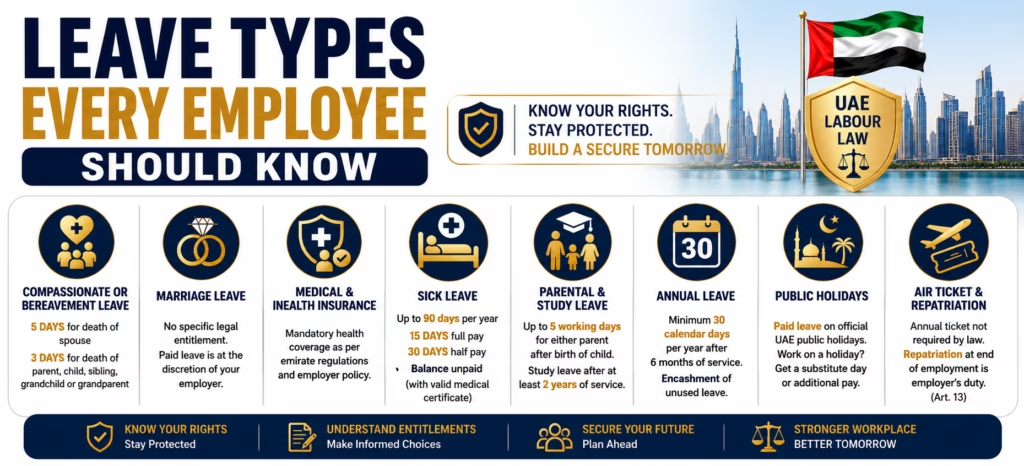
Leave Types Every Employee Should Know
Beyond annual leave, the law sets out several other paid and unpaid leave categories private sector employees should know about.
Compassionate or Bereavement Leave
Under Article 32, private sector employees get five days of paid leave for the death of a spouse, and three days for the death of a parent, child, sibling, grandchild, or grandparent, starting from the date of death. The UAE Government’s official page on compassionate leave confirms these figures.
Maternity Leave
Female employees in the UAE private sector are entitled to 60 days of maternity leave: 45 days at full wage followed by 15 days at half wage. Additional leave may be available in specified pregnancy, childbirth or child-health circumstances where the required medical evidence is provided.
Marriage Leave
Unlike some other countries, current UAE labour law does not set out a specific statutory marriage leave entitlement. If your employer offers paid leave for your own wedding, this comes from company policy rather than a legal requirement, so check your employment contract or HR policy rather than assuming a fixed number of days.
Medical and Health Insurance
Health insurance is regulated separately from the UAE Labour Law and is also affected by emirate-level requirements. From 1 January 2025, employers are required to purchase health insurance for private-sector employees and domestic workers as part of the applicable residency-permit issuance or renewal process. Coverage and implementation can vary, so employees should check the current requirements for their emirate and employment status.
Sick Leave
Employees who have completed probation are generally entitled to up to 90 days of sick leave per year, structured as the first 15 days on full pay, the next 30 days at half pay, and any remaining days unpaid, provided a valid medical certificate supports the leave.
Parental Leave
The law provides parental leave of up to five working days for either parent following the birth of a child, subject to the applicable conditions.
Study Leave
Employees who have completed at least two years of service with an employer and are studying at an accredited UAE educational institution are entitled to 10 working days of paid study leave per year to sit for examinations.
Hajj and Umrah Leave
Under the UAE Labour Law, employees may be granted unpaid leave for Hajj for up to 30 days, and this leave is available only once during the employment period with the same employer. The Labour Law does not provide specific statutory leave for Umrah. An employer may approve annual leave or unpaid leave for Umrah according to its policy.
Annual Leave
Employees are entitled to fully paid annual leave of 30 days for each year of service after completing one year. If the period of service exceeds six months but is less than one year, the employee is entitled to two days of leave for each month of service. If employment ends before the employee uses accrued leave, the employee is entitled to payment for the applicable unused leave, including the fraction of the final year, calculated according to the basic wage.
Public Holidays
Private-sector employees are entitled to paid leave on official UAE public holidays. The UAE Government determines the applicable holiday schedule, including Islamic holidays whose dates depend on the lunar calendar. If an employee is required to work during a public holiday, the law provides for compensatory rest or additional pay subject to the applicable rules.
Air Ticket and Repatriation
This is one of the more misunderstood areas of UAE labour law. The current law does not explicitly require employers to provide a recurring annual flight ticket home during your employment. Where employees do get one, it almost always comes from the specific wording of their employment contract or company policy, not directly from the law itself, so check your contract rather than assume this is a legal guarantee.
What the law does clearly require is different: Article 13 sets out the employer’s repatriation obligation when the employment relationship ends, subject to the exceptions provided by law. The obligation may not apply where the worker has joined another employer in the UAE or where another statutory exception applies. Check the specific circumstances and applicable MOHRE guidance before assuming who must bear the repatriation cost.
Worker Rights and Obligations
UAE worker laws are built around a few consistent principles that apply across almost every private sector role, regardless of nationality, job title, or salary level.
Common Mistakes People Make With UAE Labour Law
What Happens If Your Employer Breaks the Law
If an employment dispute cannot be resolved with your employer, you can submit a labour complaint to MOHRE. The Ministry may first attempt an amicable settlement. Under the current dispute-resolution framework, MOHRE can issue a final decision where the claim does not exceed AED 50,000, while other disputes that cannot be settled are referred to the competent court under the applicable procedures. (u.ae)
Separately, Article 55 provides an exemption from judicial fees for labour claims and worker or heir applications whose amounts do not exceed AED 100,000.
For help checking your work permit, labour card status and employment records, see our UAE Labour Card guide.
UAE Labour Dispute Resolution: 2025
MOHRE reported that it successfully settled 98.6% of labour disputes during 2025. This is a Ministry-reported performance figure for 2025 and should not be interpreted as a guarantee that an individual dispute will be resolved without court proceedings.
Labour Claim Time Limit
Under Article 54(9), a lawsuit concerning a right arising under the UAE Labour Law generally cannot be heard after two years from the date the employment relationship ended. Employees should not wait until the deadline to raise a dispute, because other procedural requirements may also apply.
Where to Find the Official Law Text
If you want to read the full legal text rather than a summary, Federal Decree-Law No. 33 of 2021 is published as an official PDF on both the UAE Legislation portal and the MOHRE website. For the exact legal wording, use the official UAE Legislation portal, UAE Government publications and current MOHRE legal guidance. Older third-party PDF copies may not include later amendments.
Documents Worth Keeping Throughout Your Employment
Keeping a few key documents organized protects you if a dispute ever arises over notice, resignation, or final pay. This matters just as much on day one of a new job as it does when you are preparing to leave.
Editorial Review & Sources
Reviewed by: Gratuity Calculator UAE Team
Primary legal source: Federal Decree-Law No. 33 of 2021 Regarding the Regulation of Employment Relationships, as amended, together with applicable implementing regulations and ministerial decisions.
Official guidance: UAE Government and Ministry of Human Resources and Emiratisation (MOHRE) guidance on employment contracts, termination, leave, worker rights and labour disputes.
Official reference: UAE Government – Terminating Employment Contracts
Last reviewed: September 2026. This page is checked against current UAE Government and MOHRE guidance and may be updated when legislation, regulations or official procedures change.
This guide provides general employment-law information and is not a substitute for advice from MOHRE, a qualified legal professional or the competent authority for your specific employment situation.